Baker’s Keyboard Lounge
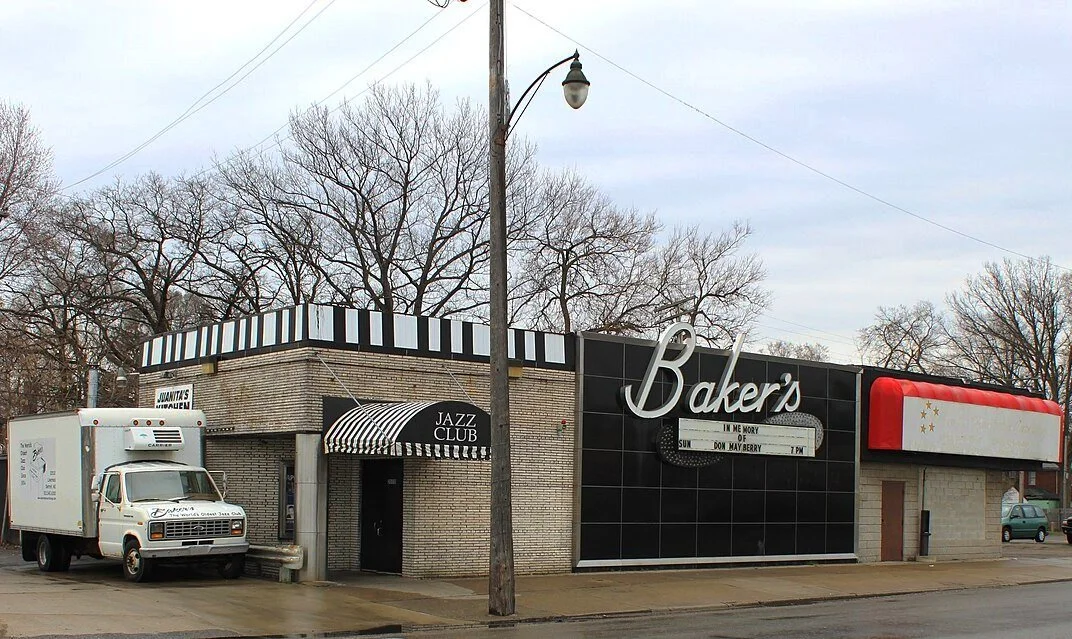
Baker’s Keyboard Lounge
This is the story of a sandwich shop that evolved into the nation’s oldest jazz club.
During the Depression last century, a woman named Frances Baker purchased a small shop on Livernois Avenue in Detroit. The shop was located about a mile from the main thoroughfare, Woodward Avenue, so there were as many cornfields as houses in the area. But Livernois was a two lane street and provided consistent traffic for the sandwich shop.
Frances and her husband ran the shop during the day. They felt they could do more business in the evenings and they recruited their son Clarence, a mortgage banker, to manage during the evenings. Clarence agreed, but found the lack of traffic at night unworthy of his time.
The Woodward Avenue bars with live music had traffic at night. So, Clarence invested in an upright piano and hired a local pianist to play in the evenings. Even though the shop had no alcohol, the pianist increased the evening traffic.
Clarence was a voracious jazz fan. He began booking local talent to play short gigs. Eventually, the shop hosted multiple shows each evening. Clarence once recalled having over a hundred people in line outside the shop hoping to get into the next show.
When Clarence’s father, Chris, suffered a stroke in 1939, Clarence took over running the shop. He began recruiting out of town jazz acts and turned the sandwich shop into a full time jazz venue. He added space under the guidance of a local architect, Phillip J. Funke. The entrance was relocated off of Livernois Avenue. They installed a bandstand in the center of the main seating. An artist, Harry Julian Carew, painted murals of major European cities on the walls, and Clarence hired local designer, Blaine Ford, to update the interior and the acoustics of the club.
Ford designed the club’s piano shaped bar, with its unique piano key drink ledge. Ford also installed mirrors above the piano so the audience could watch the pianist’s hands move. Reportedly, everything from the Italian style ceiling to the walls contributed to the acoustic environment. Baker’s became a destination where jazz aficionados gathered to listen to jazz greats.
And the musicians themselves contributed. Local legend, Pat Flowers, urged Clarence to change the name of the establishment to Baker’s Keyboard Lounge. Pianist Art Tatum insisted Clarence obtain a Steinway piano. Clarence listened to these and other people in the business. When a nextdoor establishment went under, Baker purchased it to expand the parking lot.
In Heat 1973, I used Baker’s as an inspiration for the scenes in the jazz venue called D’Ville’s. I attended many shows at Bakers in the early seventies, incredulous at my proximity to jazz legends. Clarence sold the club in 1996 and it has had two more owners since. But it continues as a Historic Detroit landmark.